
HAW-UAW Rank & File Report and Bargaining Update 12/16
Dear colleagues,
This past Monday we had our last bargaining session of 2024 and it was a memorable one. We had the pleasure of being joined by many observers and speakers. We are starting with thoughts from one observer, Lisa Gulesserian, Preceptor in Armenian Language and Culture in the Near Eastern Languages and Civilizations Department. Our bargaining update follows Lisa’s report.
Bargaining Session Rank and File Report
By Lisa Gulesserian
On Monday afternoon, in a too-small conference room on Mt. Auburn Street, I learned first hand what our union’s elected bargaining committee does every time they meet with Harvard’s lawyers and administrators to negotiate our first union contract—they fight to save our jobs and improve our working conditions. On our behalf, our bargaining committee has been negotiating for us for hours every two weeks.
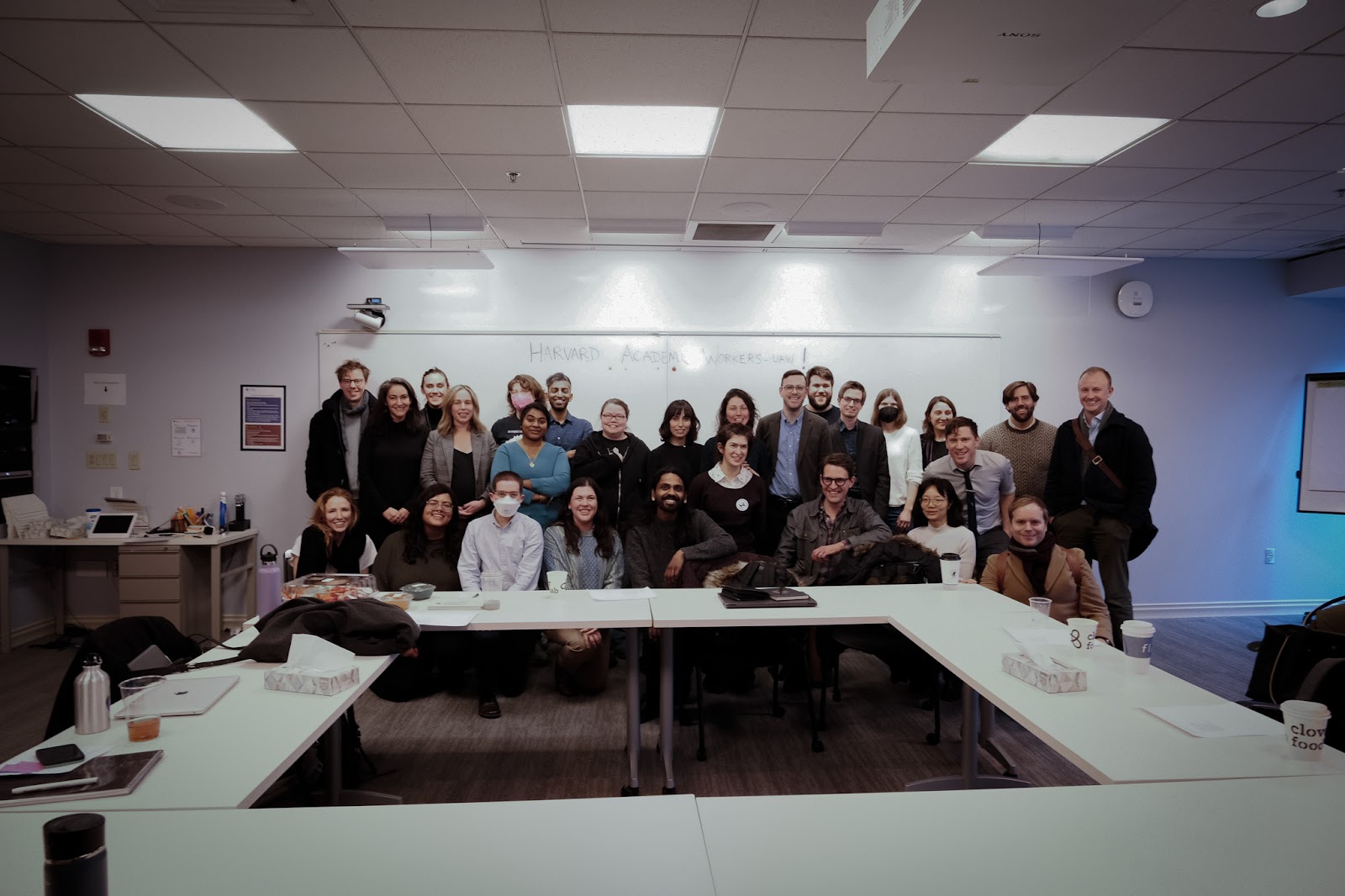
I had joined the last bargaining session of the Fall 2024 semester after being asked to provide testimony about my experience at Harvard. 10 more academic workers were present to do the same, along with dozens of observers from the “rank and file” [the workers of a particular union]. There were not enough chairs for all of us. Some of us remained standing, while others chose to sit on the floor.
Many of us had never seen a bargaining session before—we did not know many things about how a bargaining session is run. We did not know the room had “sides” (Harvard’s lawyers and administrators on one half, our bargaining committee on the other). We did not know about the private “caucus” breaks each side could take to speak privately about something proposed in negotiations. So, in our initial confusion, we accidentally sat on the Harvard administrators’ side, and we didn’t immediately leave the room when a caucus break was announced.
But despite our limited union experience, we found strength in hearing each other’s stories as we came forward, one by one, to provide testimonies in front of Harvard’s bargaining negotiators. I marveled at the secret code of post-docs who warn each other when a PI is unstable or a lab is an unsafe environment. I was troubled to hear that one of us is mired in thousands of dollars of credit card debt for the move-in costs of living in a run-down apartment in Cambridge. I found common cause with other award-winning instructors—one who is pregnant and will soon lose health insurance coverage—who will be forced to leave their students and the jobs they love in six months because of Harvard’s time cap policy.
I have never been involved in a union before being recruited by my colleague to join the efforts of Harvard Academic Workers–United Auto Workers, the union that represents us—post-docs, non-ladder teaching faculty, researchers, and skilled staff. So, when I was asked to read a testimonial at a bargaining session about my experience as an academic worker at Harvard, I didn’t know what I was about to experience at a bargaining session. Attending this session, sharing my story, and hearing about the accomplishments and plights of my fellow workers has energized me to do more to save our jobs and to make sure that our employer treats us with dignity and respect.
Our bargaining committee has already proposed over two dozen non-economic articles—they have negotiated to ensure we have the tools and spaces we need to do our work in restructured and dignified job titles. But our bargaining committee needs our help to secure significant economic gains. Our collective strength is necessary for us to see real improvements in our wages and benefits for contingent and unstable academic positions while living in one of the most expensive metro areas in the United States.
So, what can you do to support our bargaining committee’s efforts to fight for better working conditions for all of us? Here are some ideas:
- Attend a union bargaining session! The meetings are open to all union members.
- Wear a union pin! We will give you one.
- Put up flyers about time caps or living wages! We can give you copies.
- Spread the word on social media! We can use your tech-savvy skills.
- Talk to your colleagues and coworkers about your working conditions and our union! We need everyone on board.
I am proud that I am contributing to the efforts that protect our jobs, our livelihoods, and our dignity. Join us…the bargaining committee cannot do this on their own!
HAW Bargaining session #8
December 16th 2024
Bargaining update
A small part of the meeting was business as usual; we presented counters on Discipline and Dismissal and Access to Services and Workspace, and the administration presented us with their counter for the Grievance and Arbitration article.
- Grievance and Arbitration: The administration insisted on shortening the timeline available to file an initial grievance, arguing that is standard practice in other unions to have around 30 days. Importantly, they finally agreed with our removal of their proposed Step 3, which would have added an extra 12 weeks to the Grievance procedure. The administration has now agreed with us on a more streamlined process.
- Discipline and Dismissal: In line with the many testimonials of this session, we insisted on the importance of non-reappointments being considered a form of dismissal—this would mean that one can only be non-reappointed for just cause. We also reasserted that the Employer must notify Employees of their union rights ahead of any disciplinary or investigative meeting. Finally, we agreed to remove a section of the article dealing with confidentiality, because this confidentiality is already protected by the Employment Records article.
- Access to Services and Workspace: Here we agreed with several of the administration’s changes around the parameters of email and office space, but re-asserted the importance of workers being provided with computers and having a period of continued access to email and library services after their appointment ends. In this discussion we felt the enormous benefit of having rank and file workers join us during bargaining, offering live feedback that allowed us to counter effectively. The administration had removed class spaces from the list of facilities to be provided by the Employer, arguing that it is implied you will be given a classroom space if you are teaching. Many of the observers and speakers, however, shared that they had not been promptly assigned class spaces or had had to conduct tutorials in their own offices. They were able to directly communicate these experiences at the table, which resonated loudly with the administration, who claimed that this was new information.
In our closing remarks, we reemphasized that the following 38 days until our next bargaining session will be more than enough time for the administration to come back with some proposals for the many issues we have presented, which are very pressing and paramount we come to some agreement on.
The big highlight of this session was, however, the powerful company we had and how poised, eloquent, and assertive all the speakers were. The speed at which administration has been working thus far had created a sense of stillness that was very strongly countered by the urgency that the speakers so clearly communicated. With this, we close a successful semester of bargaining, which has brought us many steps closer to guaranteeing the working conditions that we all deserve.
In solidarity,
HAW-UAW Bargaining Committee