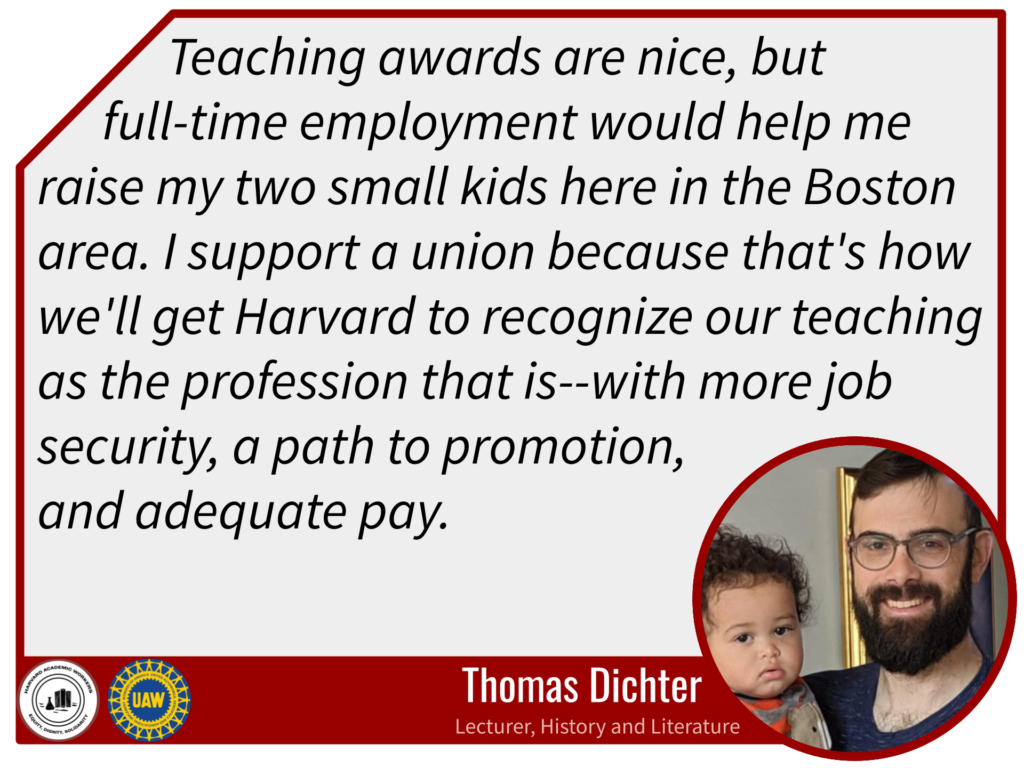

ABOUT US
We are Harvard Academic Workers, a union of non-tenure-track researchers and teachers across Harvard. We currently consist of two units (see our FAQ for more info on what that means): FAS/HMS/HDS, postdocs, lecturers, instructors, teaching assistants, core facility scientists, and more; and HLS clinical workers. These bargaining units were recognized by the NLRB in April 2024, after winning our elections with an overwhelming majority (>93%!) of YES votes. We are now in the process of bargaining with Harvard for our first contract to improve our working conditions.
It’s an exciting time for our new union, as we decide what we want our working lives to look like and work together to make a better Harvard! We strive to use our collective power and voice to participate in the academic community at Harvard and beyond, make the academic career path one anyone can afford to pursue, and strengthen the research and teaching objectives of the University. We encourage all research and teaching workers in HAW to participate in this process: our union is what we make it!
Our Union
This is your union if: (1) Harvard is your employer; (2) you do research or teaching work, but not as a student or tenure-line professor; (3) you’re not a manager or a supervisor. The nature of your work (not your job title or your fellowship) determines your eligibility. If you have any questions about this, please get in touch! You are a member of an existing bargaining unit if you work at the Faculty of Arts and Sciences (FAS), Harvard Medical School (HMS), Harvard Divinity School (HDS), or in the Harvard Law School (HLS) Clinical Programs.
To join the union, sign a card!
Committees
Our union consists of several committees and working groups that keep things running!
Bargaining Committees: We have one bargaining committee (BC) for the HLS-C unit and one for the FAS/HMS/HDS unit. The role of the BCs is to meet with the administration and propose and negotiate a contract that will determine our working conditions. Each BC is made up of elected positions from across the unit. If you are interested in running for the BC, please contact hawuawbc@gmail.com.
Organizing Committee: The job of the organizing committee is to build community and facilitate communication between union members and the bargaining committee. Anyone can join organizing committee. We meet once per week, and you’re welcome to come as often as you can. If you’d like to join, please contact harvardacademicworkers@gmail.com.
Working Groups:
International Working Group: This working group is currently helping to advise on what provisions we want in our contract for international workers.
Postdoc Working Group: This working group is currently working to organize postdocs and also to advise on what provisions we want in our contract for postdocs.
Time Caps Working Group: this working group is currently organizing to abolish the time caps policies that affect the length of employment of teaching faculty!
If you’re interested in joining a working group (or making a new one!) please contact harvardacademicworkers@gmail.com.
Here’s some of what our members are working to achieve together!
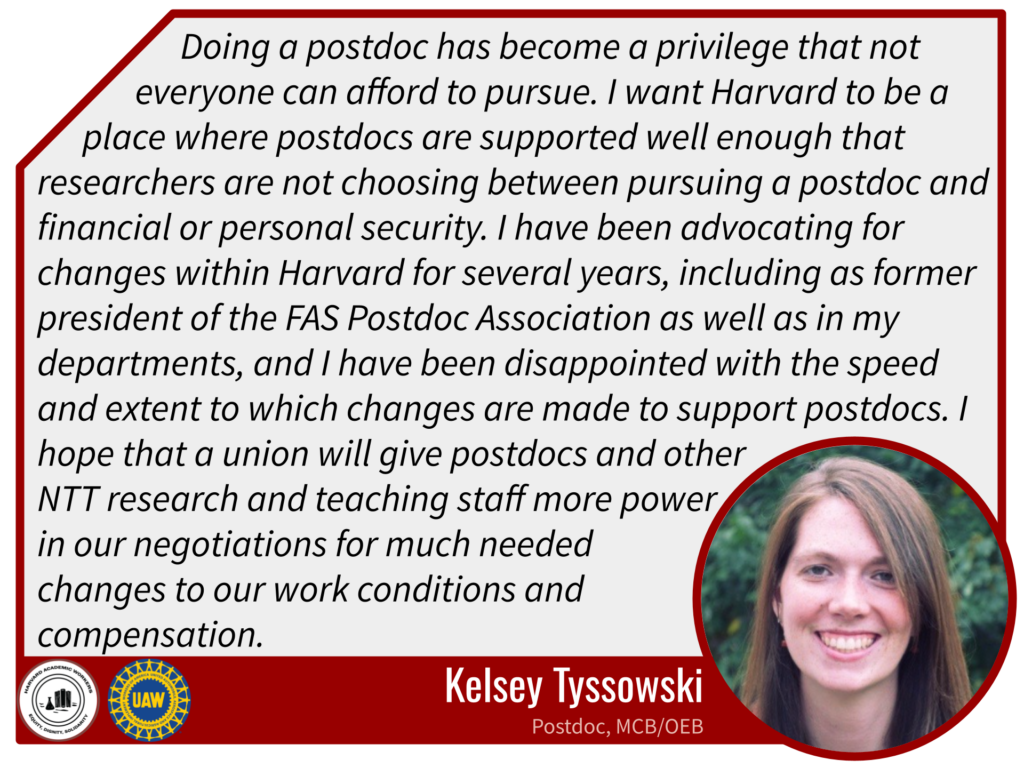
Wages that keep up with the cost of living in one of the most expensive region in the country
Wages for many academic workers have failed to keep up with the cost of living.
Wages for many academic workers have failed to keep up with the rising costs of living. Our union wants to change that!
At other universities, unionized workers workers have been able to win significant improvements to their wages. Barnard contingent faculty bargained for 16% raises in their first year of their contract.
Postdocs at Columbia won 14.5% raises in their first year of their first contract, and 24% in increases over the three years of their current contract.
Mt Sinai postdocs won raises to make them the highest paid postdocs in the country, starting at $72K and earning $80K at the 4th year of employment!
If you’d like to help in the fight for better wages, please email us at harvardacademicworkers@gmail.com!
Fighting against time caps and earning the job security we deserve!
Many non-tenure-track (NTT) teaching and research positions are subject to “time caps”—arbitrary limits imposed by the Harvard administration on the maximum term of employment.
Many non-tenure-track (NTT) teaching and research positions are subject to “time caps”—arbitrary limits imposed by the Harvard administration on the maximum term of employment. Workers in these positions “time out” of employment after a fixed number of years. We are working together to improve our job security and reduce turnover, thus supporting and cultivating the valuable experience and expertise that we bring to the university.
The specifics of these policies vary across Harvard, but the problem is pervasive. Within the Faculty of Arts and Sciences (FAS), College Fellows, Lecturers, and Preceptors each time out after 2, 3, and 8 years, respectively. NTT teachers may not hold any combination of appointments in those positions for more than 8 years, “regardless of how many or what type of appointments (including teaching assistantships and tenure-track faculty appointments) the individual has held in the past.” Time caps deny us the opportunity for stable, long term employment. Time caps also disrupt the education of our students by increasing instability and churn. Students cannot depend on consistent relationships with teachers, mentors and research partners, disrupting the quality of their education.
Harvard is one of two schools with this arbitrary policy. And even at Harvard, not all NTT positions have time caps—even here at Harvard. Lectureships in the Faculty of Medicine and the T.H. Chan School of Public Health, for instance, may be renewed indefinitely, a model that could be extended to every Harvard school.
Other unions that represent NTT teachers and scholars have won fair reappointment procedures. Some recent union wins related to Time Caps and Reappointment Procedures:
- Secured contractual right to presumptive renewal with no arbitrary time limit, delineation of accrual of seniority for NTT faculty, and increased compensation [bargained for by NTT faculty at the University of Michigan (LEO-AFT MI Local 2644).
- Presumption of reappointment within contracts for salaried lecturers, conditional on a bargained-for process of performance review [bargained for by lecturers at Boston University (SEIU 509)].
- Contractual presumptive renewal as part of a landmark framework agreement in alliance with grad workers and tenured faculty (bargained for by NTT faculty at Rutgers).
If you’d like to help abolish time caps, you can join the Time Caps Committee – please reach out (harvardacademicworkers@gmail.com) and we’ll put you in touch!

Better protections from bullying, harassment and discrimination
Protection from harm is one of the five essentials for workplace mental health and well-being outlined by the U.S. Surgeon General.
This requires active enforcement through accountability. Unions like HAW-UAW can act as agents of protection and advocacy for its members by holding institutions responsible to existing policies and demanding necessary change to increase safeguards for academic workers.
Bullying and harassment are issues here at Harvard and something we aim to address in our bargaining process. Recent reports show that academic harassment and bullying is still all too common, including internal surveys at Harvard. In 2022 the Faculty of Arts and Sciences (FAS) Postdoc Survey found 11% of FAS postdocs experienced bullying within the last year, with some departments reporting rates as high as 25%. In a 2020 climate survey from FAS, 22% of non-tenure track faculty reported experiencing bullying and 60% reported experiencing incivility. Even when supported by internally generated data, the university has taken no concrete steps toward remedying this pervasive problem. With our contract, we aim to hold the university to account and help ensure the it protects all its affiliates from harm, regardless of title.
We’re taking notes on wins other unions have made in this area:
- Established industry-setting protections against abusive conduct and bullying (UC-UAW)
- Forced their institution to create a committee with an enforceable timeline for the development of university-wide policy to address bullying (CPW-UAW)
- Increased protections around the process for discrimination and harassment issues including access to neutral third-party arbitration (negotiated by University of Washington Academic Student Employees and Postdoc Union (UAW-4121)
If you’d like to help us win a strong contract that addresses bullying and harassment, reach out to harvardacademicworkers@gmail.com!
Protections and support for international scholars
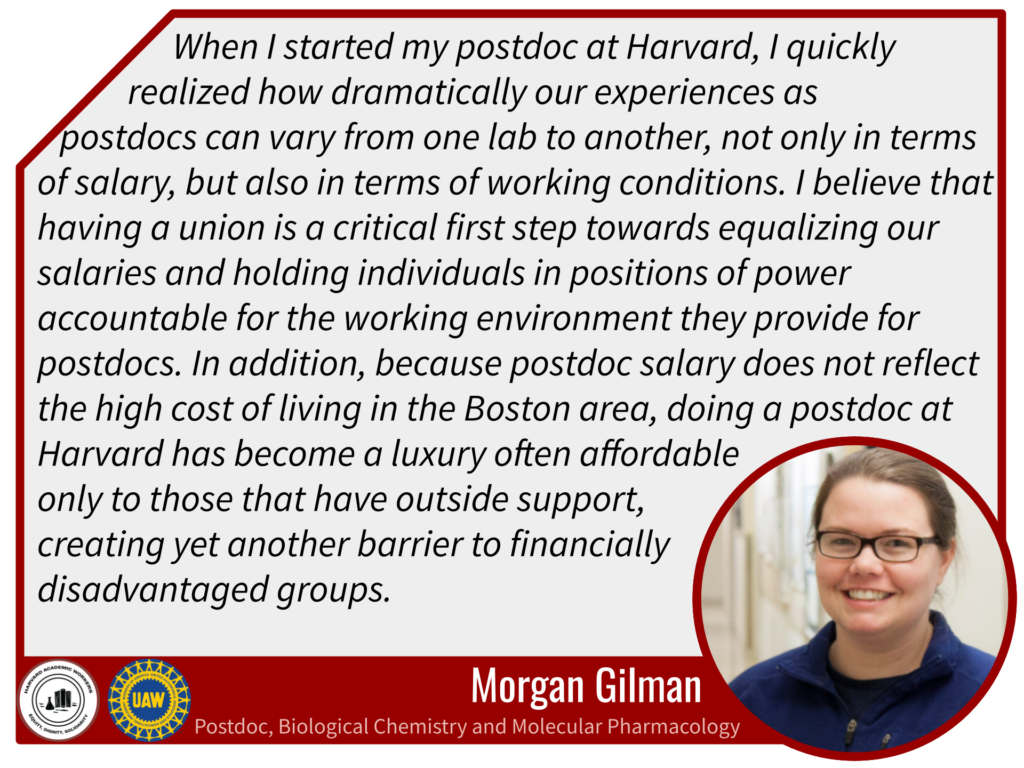
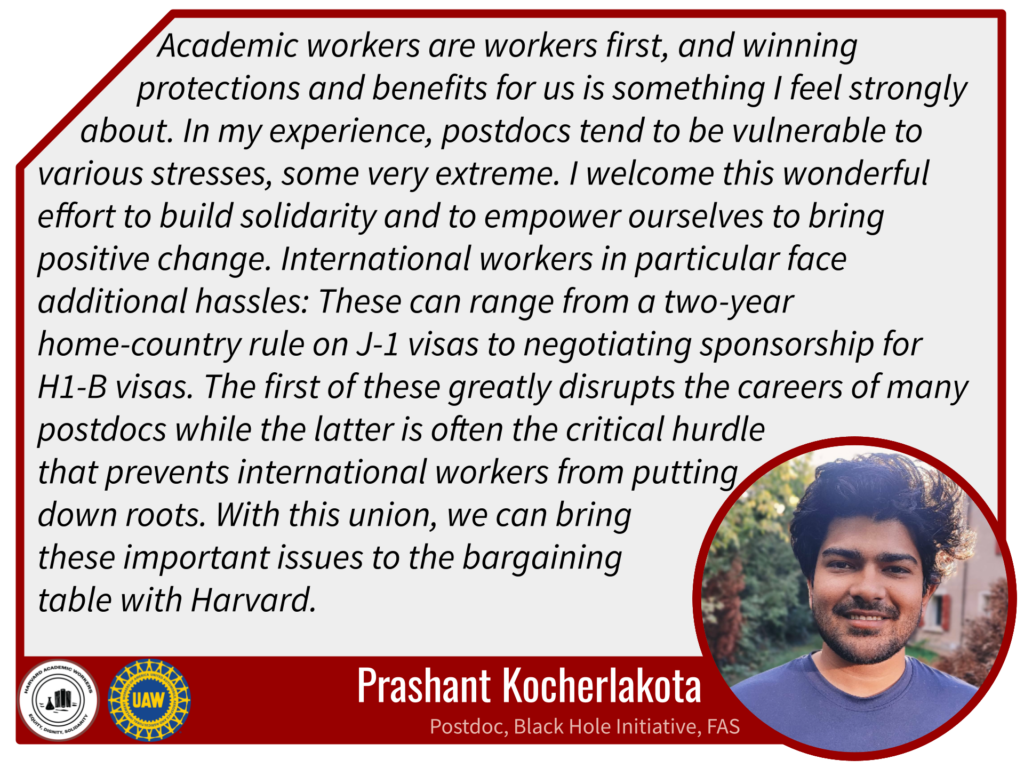
International scholars and workers are an integral part of Harvard, but we face additional challenges and burdens stemming from our standing as visa-holders.
International scholars and workers are an integral part of Harvard, but we face additional challenges and burdens stemming from our standing as visa-holders. For many of us, our legal status in the country is directly tied to our status as a Harvard employee.
International workers have the same rights to support and join unions as domestic workers. See https://harvardacademicworkers.org/faqenglish/
In addition, recent literature shows that academic harassment and bullying is a particular problem for international workers and others in marginalized positions. Threats to visa status can and are used to coerce international workers into working overtime and/or doing work outside their official responsibilities.
By building power through HAW-UAW, international workers can hold the university to account and help ensure the university protects all its affiliates from harm, regardless of citizenship status.
A 2020 survey in Harvard’s Division of Science had approximately half of the 1,200+ respondents report not holding citizenship status. Late contracts, unofficial appointment letters, and canceled classes have disproportionate and severe consequences for workers with insecure residency status. Short term contracts make international workers vulnerable to deportation. Technicalities make visa holders ineligible for benefits, such as childcare subsidies, that are made available to domestic workers doing the same work. Visa holders are additionally responsible for the financial burden of maintaining visa status. Unions like HAW-UAW can fight to ensure institutions regularize policies and contracts to address these vulnerabilities.
Recent Union Wins Related to Visa and Immigration Issues
- Established funds to help defray costs associated with immigration and maintenance of legal working status (negotiated by the Harvard Graduate Students Union, HGSU-UAW, in 2022)
- Increasing initial appointment minimums from one year to two years (negotiated by the University of California Postdoc Union, UAW 5810)
- Guaranteed leave time for immigration appointments and protections should immigration laws change, UAW 5810)
- Increased offer windows to accommodate work authorization timelines (negotiated by the Columbia Postdoc Union , CPW-UAW)
- Visa fee reimbursement fund established to defray costs associated with immigration (negotiated by UMass Amherst Postdoc Union, PRO-UAW)
If you’d like to work on issues relevant to international workers, you can join the International Workers Working Group – reach out to harvardacademicworkers@gmail.com, and we’ll get you looped in!
Making Harvard more family friendly for academic workers
Massachusetts has one of the highest costs of childcare in the nation.
Massachusetts has one of the highest costs of childcare in the nation. The median annual cost of full-time care for one infant in Middlesex and Norfolk Counties is $26,409 (childcare centers on the Harvard campus charge as much as $42,720). Recognizing these costs, the university rightly offers ample support for its tenure-track (TT) faculty and upper-level administrators, who are offered generous childcare subsidies for household incomes up to $250,000. Yet it provides far less support to non-tenure-track (NTT) faculty. A NTT faculty household earning $150,000 will receive no childcare assistance under current programs, while a TT faculty household earning the same income receives $12,000.
Harvard has a responsibility to support all parents who provide labor to the University. Workers in other academic unions, such as Columbia University’s CPW-UAW 4100, University of California’s UAW-5810, and Harvard’s own Graduate Student Union (HGSU-UAW 5118) have been able to win substantial improvements in parental leave and childcare assistance. With a seat at the table, we can fight to close the equity gap between TT and NTT faculty, seeking much-needed support to helpHarvard’s academic worker parents care for their families while they carry out the University’s core academic functions.
If you’d like to help us win a contract that supports parents, please reach out to harvardacademicworkers@gmail.com!